

Nylon vs Leather Lifting Belt: 7 Useful Buying Checks
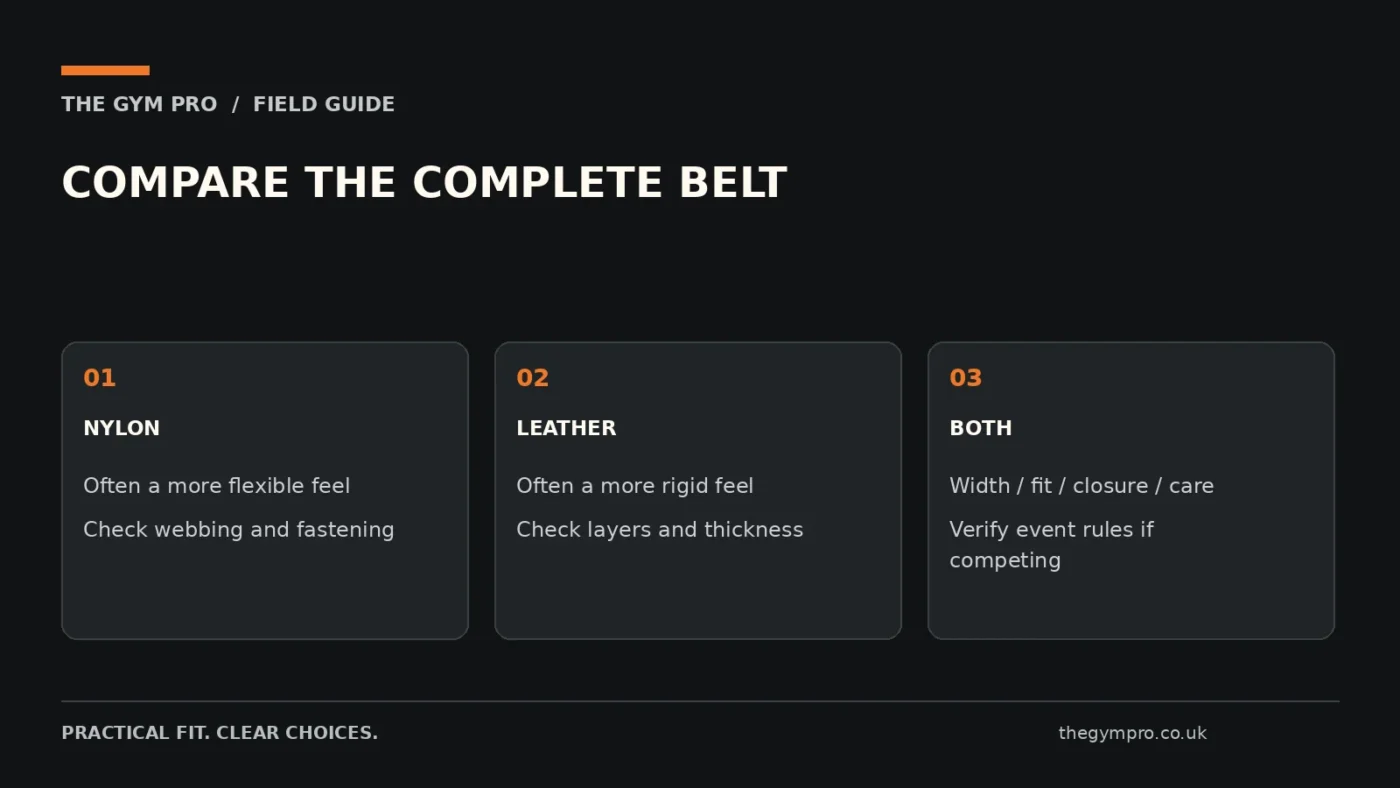
A nylon vs leather lifting belt comparison usually comes down to flexibility, stiffness, fastening and how the belt suits your exercises. Many leather belts feel more rigid, while many nylon designs are lighter and more flexible. Construction varies, so the material name alone cannot rank every product.
Table of Contents
Nylon vs leather lifting belt: start with construction
Choose the complete belt, not just a material category. Width, thickness, lining, edge shape and closure can change the experience considerably. A comfortable belt you know how to use is more useful than the most imposing-looking option.
| Check | Leather designs | Nylon designs |
|---|---|---|
| Stiffness | Often more rigid; thickness and layers matter | Often more flexible; inserts and webbing matter |
| Shape | Uniform or tapered widths | Uniform or tapered widths |
| Fastening | Commonly prong or lever | Commonly buckle and hook-and-loop arrangements |
| Adjustment | Depends on hole spacing or lever design | Often fine adjustment, depending on closure |
| First use | Some need gradual familiarisation | Often flexible from the start |
| Care | Follow instructions for the hide, lining and finish | Follow instructions for webbing and fastener |
| Competition | Check exact rules and approved equipment | Check exact rules; do not assume eligibility |
These are common patterns rather than universal specifications. A product described as leather may include multiple materials, and a nylon belt may include padding or a stiff insert.
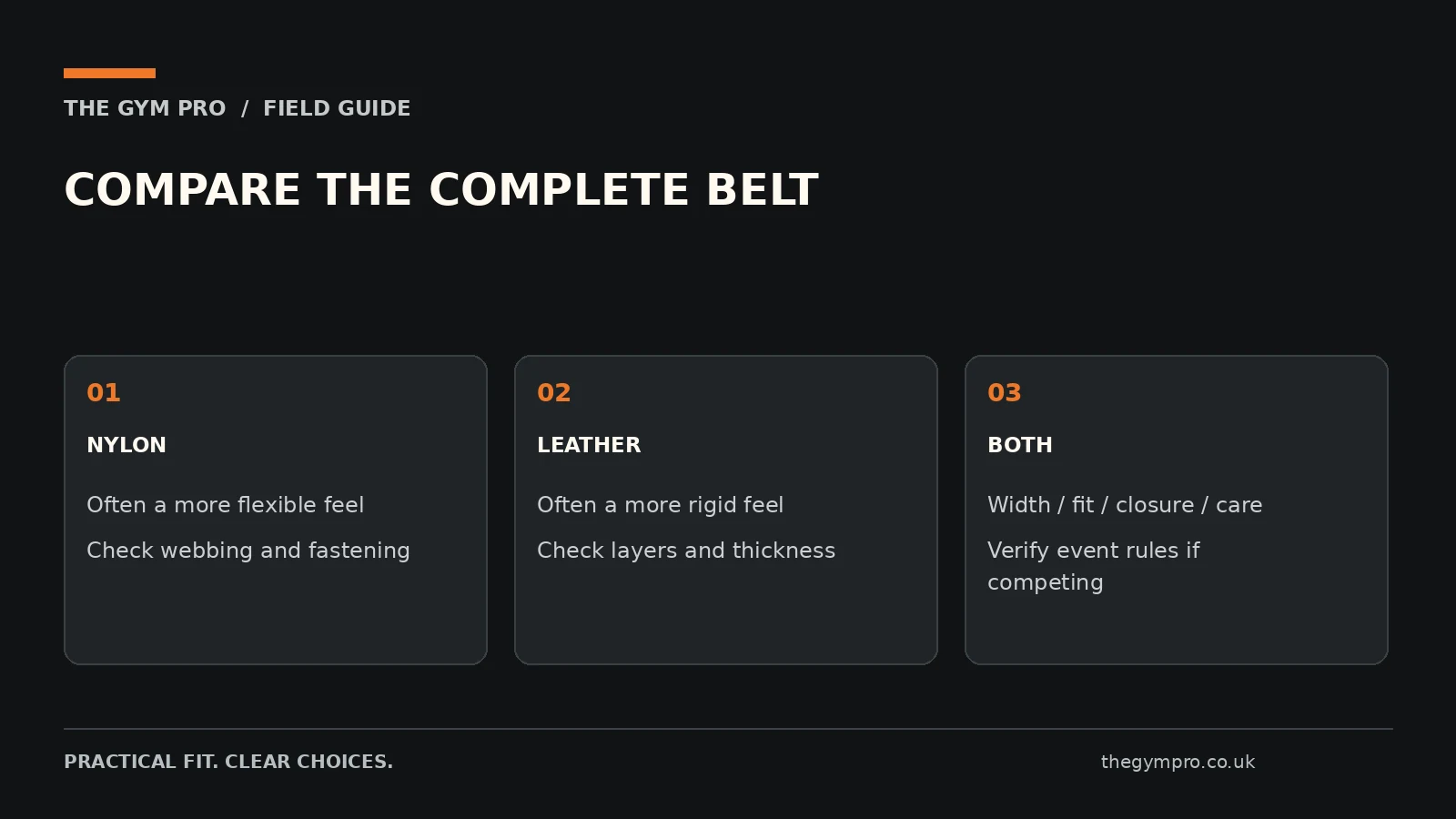
Match the belt to the training you actually do
If most of your belt use is on barbell squats and deadlifts, you may prefer a firmer surface to brace against. If you move quickly between different activities, you may prefer something easier to loosen and less rigid. Try the options where possible.
Olympic weightlifting, bodybuilding, general strength training and conditioning can involve different movement demands. That does not mean every person within one activity needs the same material. The belt’s shape and your individual fit remain important.
You do not need a belt for every exercise or as an automatic first-day purchase. Our beginner lifting-belt guide explains how to introduce one without replacing the work of learning a brace.
A belt does not create a universal safe lifting threshold or guarantee a stronger lift. Use appropriate loads and familiar technique. If you are unsure how to use it, get instruction rather than tightening it as far as possible.
Compare stiffness, width and torso fit together
Leather thickness is only one contributor to stiffness. Layers, lining and finishing matter too. Two belts sold at the same nominal thickness may not feel identical. Nylon designs also differ in webbing, inserts and how the closure carries tension.
Width affects where the belt contacts the torso. If the edges interfere with your ribs or hips, compare position and shape rather than assuming a material change will solve everything. A tapered belt and a uniform-width belt can feel different even when made from similar materials.
Our belt-thickness guide and belt-position guide cover those separate decisions. Keep notes on what you tried so your next purchase is based on something more specific than a material label.
When testing, stand and take your normal unloaded setup for the lifts involved. A belt that feels acceptable upright may behave differently when you hinge. Do not force an unfamiliar movement to make equipment feel suitable.
Nylon vs leather lifting belt: fastening checks
A single-prong buckle, double-prong buckle and lever are different ways of securing a belt. A lever can make repeated opening and closing convenient, but changing the set circumference depends on its design. Some require tools; others offer adjustment mechanisms.
Nylon belts often use a buckle with hook-and-loop fastening, but the exact arrangement matters. Check the manufacturer’s instructions, the amount of overlap and the condition of the fastening. Keep lint out of hook-and-loop areas and stop using damaged equipment.
Do not assume one closure is automatically secure because it looks substantial. Inspect the complete system and use it as intended. A loose screw, damaged buckle or worn fastening deserves attention regardless of material.
Our lever versus prong comparison explains fastening trade-offs. For any purchase, confirm how that particular model is adjusted before deciding whether it fits your routine.
Care, sizing and material descriptions
Measure at the intended belt position and follow the correct size chart. Your trouser waist is not a dependable substitute. A flexible belt still needs a suitable adjustment range, and a stiff belt is not improved by buying it too small.
Leather, suede and coated synthetic materials can need different care. Do not soak, oil or heat a belt without the manufacturer’s instructions. Nylon construction does not automatically mean machine washable either. Hardware, lining and inserts may need separate consideration.
Our cleaning and storage guide gives a cautious workflow. Let equipment dry appropriately after training and inspect it regularly. A lower-maintenance routine still requires checking the fastening and overall condition.
Read material descriptions precisely. PU leather is a coated synthetic material, not another name for full-grain hide. Our Mr Olympia weightlifting belt is listed as PU leather, so it should not be used as evidence of how a full-grain leather belt will behave.
For a manufacturer’s comparison of nylon and leather designs, see REP Fitness’s belt-material guide. Its product-specific features apply to the belts it describes, not every belt sold under those material names.
Read leather descriptions as separate specifications
Full-grain leather, split leather, suede and PU leather are not interchangeable descriptions. A listing may also describe only the visible outer layer rather than every material inside the belt. Ask what the construction includes if the distinction matters to your purchase. Do not infer the complete material from the colour, texture of a photograph or the presence of a metal buckle.
This matters in a nylon vs leather lifting belt comparison because the category can otherwise become misleadingly broad. Compare a specific nylon design with a specific leather construction, using the dimensions and closure information for each. If a seller has not supplied a thickness, do not invent one from a side-view photograph. A clear specification and a suitable adjustment range are better buying evidence than an unsupported heavy-duty label.
Competition checks and common questions
Before buying for a meet, consult the event’s current federation rules and any approved-equipment list. Material, dimensions, fastening and brand approval can all matter. A belt being sold for powerlifting does not certify competition eligibility.
Is leather always better than nylon?
No. A firmer belt may suit your preference for certain lifts, while a flexible design may be more convenient for another session. Compare actual construction, fit and intended use.
Can beginners use a nylon lifting belt?
They can if it fits and they understand how to use it, but beginners do not automatically need one. Learn the exercises and bracing rather than treating any belt as a shortcut.
Does every leather belt need breaking in?
No single routine suits every material and finish. Some feel stiff initially. Follow the maker’s guidance and do not soften a belt with aggressive heat, soaking or unapproved products.
How do I choose a nylon vs leather lifting belt online?
Ask for the material, dimensions, closure instructions and size range. Compare equipment you have tried, check returns conditions and verify competition requirements if relevant. Buy a known specification rather than an unsupported promise.
SHOP OUR TOP GYM PRODUCTS
Body Composition Scale with Handheld Sensor & 1.5 m Cable
£124.99Original price was: £124.99.£89.99Current price is: £89.99.Heavy Washed Gothic Hoodie – Oversized Y2K Streetwear
Mr Olympia Weightlifting Belt – PU Leather for Squats & Deadlifts
£45.99Original price was: £45.99.£38.99Current price is: £38.99.No Pain No Gain Weightlifting Belt – Heavy-Duty Support
£32.99Original price was: £32.99.£26.99Current price is: £26.99.Tren and Jerry’s T-Shirt – Funny Gym Pump Cover
Sam Sulek Certified Women Avoider T-Shirt – Cotton Gym Tee
Mr Olympia Muscle-Fit Sweatshirt – Vintage Bodybuilding Top
£33.99Original price was: £33.99.£26.99Current price is: £26.99.Powerhouse Gym T-Shirt – Vintage Oversized Washed Cotton