


How to Tell If Leggings Are Squat Proof: 7 Useful Checks
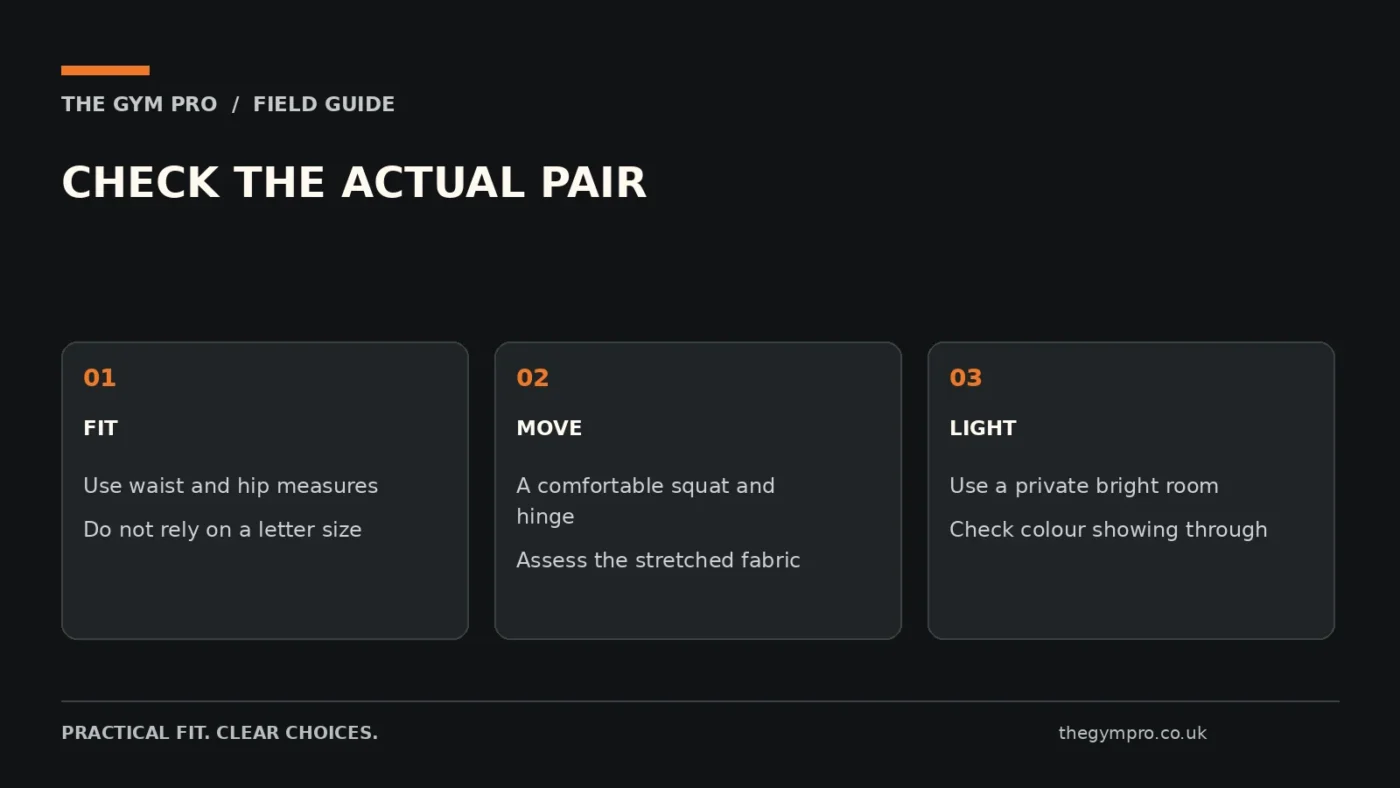
To understand how to tell if leggings are squat proof, check the actual pair in your chosen size and colour while the fabric is stretched during movement. Use bright, ordinary lighting and a mirror or a trusted person’s help. Check for transparency, rather than treating every visible underwear seam as a failed opacity test.
Table of Contents
How to tell if leggings are squat proof: test the actual pair
A product name, dark colour or seamless finish cannot establish the result on your body. Fabric construction, stretch and fit all affect what happens. This guide is a practical shopping check, not a laboratory certification or a claim that every pair in our shop has passed.
| Check | What to assess |
|---|---|
| Size chart | Waist and hip measurements against the actual listing |
| Standing fit | No obvious pulling, slipping or excessive looseness |
| Comfortable squat | Fabric across the seat while it stretches |
| Hip hinge | Coverage when bending forwards |
| Lighting | More than one ordinary bright-light position |
| Seams and waistband | Comfort and stability during movement |
| After care | Recheck the garment as it ages |
Keep your privacy in mind. You do not need to upload a photograph to make this decision. A mirror, a private room and a trusted person can be enough.
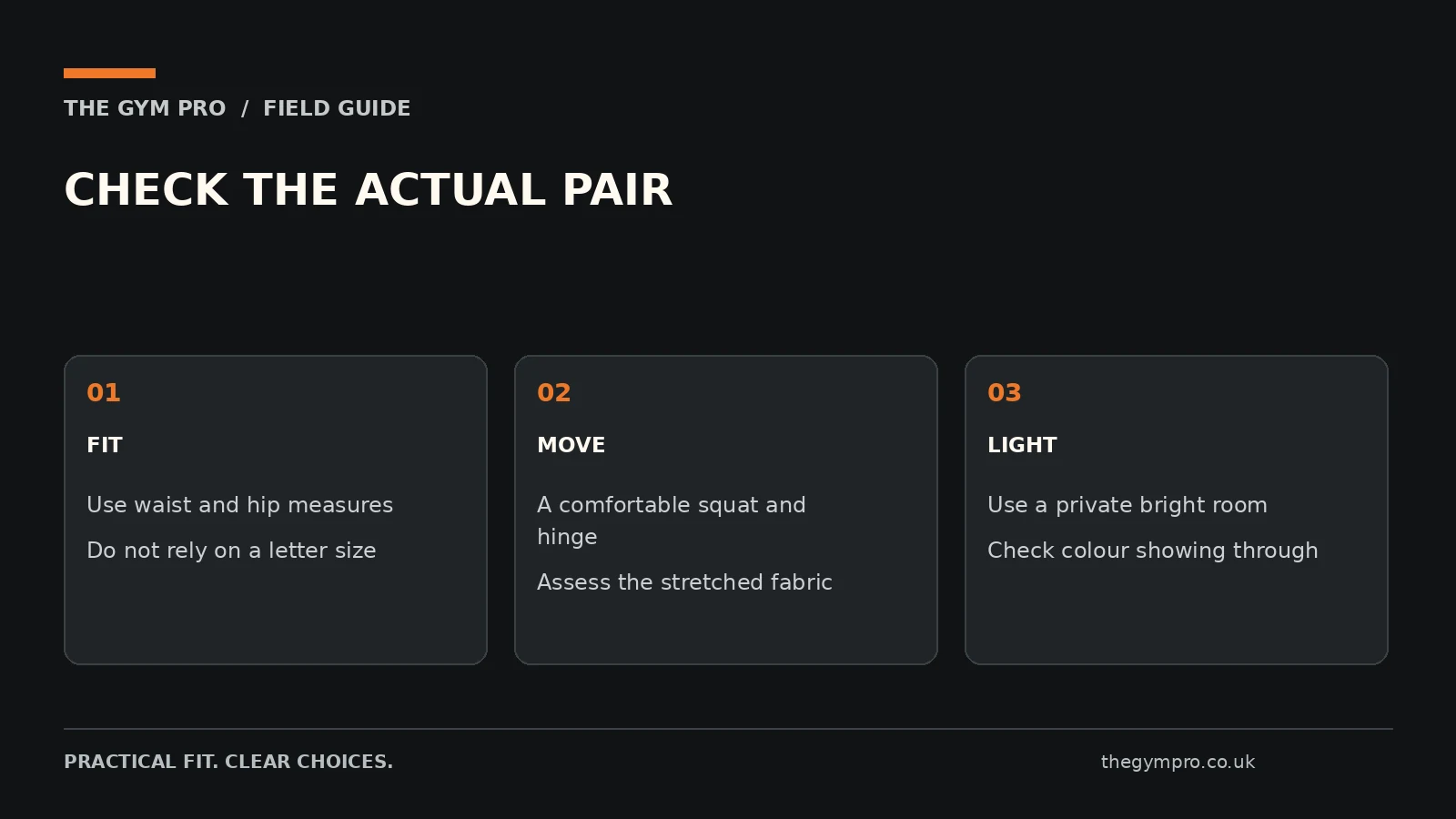
How to tell if leggings are squat proof: start with fit
Take your waist and hip measurements using the listing’s instructions. Compare them with the correct chart for that product. Do not assume another brand’s medium or a previous pair’s size will fit the same way.
A garment stretched beyond its intended fit can become more transparent. If it pulls strongly across your hips, digs in or limits movement, check the fit rather than accepting the discomfort because the fabric is described as compressive.
Sizing up is not a universal fix. A larger pair may slip or bunch at the waist. If one size is restrictive and the next is unstable, another cut or fabric may suit you better. The goal is a workable fit through the whole garment.
Our gym-legging buying guide considers waistband, length and comfort. This article focuses specifically on assessing opacity and distinguishes it from those broader fit questions.
Test the positions you will actually use
Put the leggings on with the underwear you expect to wear while training. In a private space, check standing, a comfortable squat and a hip hinge. Move within your usual range rather than forcing an unfamiliar position.
Use a mirror positioned so you can see the seat and upper thighs without twisting awkwardly. If another person helps, ask them specifically whether the underlying colour shows through when the fabric stretches. A photograph can also help if you choose, but keep it private and consider whether the camera changes the lighting.
Check more than one lighting direction. A dim bedroom and a bright gym can produce different impressions. Strong backlighting can also be more revealing than light directly in front of you. You are checking a practical situation, not trying to create an unrealistic test that no garment could pass.
Repeat the check with the actual colour you intend to keep. A different dye or fabric panel can behave differently, even within a similar-looking range. One colour passing does not prove every colour will.
Separate transparency from visible lines
A visible seam or underwear outline does not necessarily mean the fabric is see-through. Close-fitting clothes can show texture underneath while remaining opaque. Transparency means underlying colour or skin is visible through the stretched fabric.
If the issue is an outline rather than transparency, you may prefer a different underwear shape or seam placement. That is a comfort and appearance decision. Avoid buying a smaller size in an attempt to smooth lines; more stretch can create another problem.
Likewise, a visible scrunch seam is a design feature rather than a direct opacity measure. Our scrunch bum gym leggings have contour detailing, while our high-waisted seamless leggings offer a different look. Assess each actual garment rather than assuming either style guarantees coverage.
If a seller explicitly makes a squat-proof claim, read what it covers and ask how it was assessed. Check the returns conditions before wearing or washing a garment beyond an ordinary fitting.
Why thickness and colour are only clues
A substantial fabric can still become transparent if its structure opens when stretched. A lighter fabric can perform differently depending on its knit and construction. Fabric weight, sometimes stated as GSM, is useful context but not a complete opacity test.
Dark colours often make visual comparison easier for some shoppers, but black is not an automatic pass. Stretch, fit and light still matter. Pale fabric is not automatically unsuitable either; judge the actual pair.
Seamless describes construction and appearance. It does not mean there are no stitched areas at all, nor does it prove that the fabric will remain opaque. Look at the waistband, gusset and panels as parts of the complete garment.
For a manufacturing perspective on why GSM and knit construction are separate, Sportswear Partner discusses fabric specifications. Use those details as background, not as a substitute for checking a finished pair on you.
A private fitting check with a clear question
Before checking a new pair, decide what you are assessing. Is the underlying colour visible through stretched fabric, or can you only see a seam outline? Those are different observations. Check standing and during a comfortable squat, then compare a second lighting direction. If a trusted person helps, ask that specific question rather than simply asking whether the leggings look good.
Knowing how to tell if leggings are squat proof also means recognising the limits of a fitting. A private check can help you decide whether the pair meets your coverage preference, but it cannot certify every size or colour in a range. Keep notes on the pair, size and colour you assessed. If you return it, describe the issue accurately so the seller can understand whether the problem was opacity, fit, seams or a slipping waistband.
Recheck coverage as leggings age
Follow the garment care label and allow the pair to dry properly. Repeated wear and washing can change how clothing looks and feels. If you notice thinning, damaged seams or a waistband that no longer stays put, reassess the pair before relying on it for a session.
Do not assume a pair that passed once will remain unchanged indefinitely. Equally, do not discard comfortable clothing because of an arbitrary wash count. Inspect the actual condition and how it performs during movement.
How do I tell if leggings are squat proof without taking a photo?
Use a mirror in a private, well-lit space or ask a trusted person to check. Look specifically for underlying colour showing through when the fabric stretches.
Are seamless leggings always squat proof?
No. Seamless construction does not guarantee opacity. The actual fabric, size, colour and movement determine what you see.
Will sizing up stop leggings being see-through?
It may help if the original pair was overstretched, but it can also create a poor fit elsewhere. Use the chart and consider another cut if neither size works.
Can I judge squat-proof leggings from product photos?
Photos help shortlist a style but cannot reproduce your fit and lighting. Knowing how to tell if leggings are squat proof means checking the pair you receive before committing to it.
SHOP OUR TOP GYM PRODUCTS
Barbell Brigade Pump Cover – Bronze & Red Gym T-Shirt
Mike Mentzer Clothing – Uncrowned King Cotton T-Shirt
I’m Afraid of Women Gym Retro T-Shirt – Funny Bodybuilding Tee
Berserk Lever Belt – Anime Powerlifting Gym Belt
£84.99Original price was: £84.99.£69.99Current price is: £69.99.Body Composition Scale with Handheld Sensor & 1.5 m Cable
£124.99Original price was: £124.99.£89.99Current price is: £89.99.Samurai Weightlifting Belt – Japanese Calligraphy Gym Belt
Loose Bodybuilding Trousers – Hardcore Gym Workout Pants
Creatine Meme T-Shirt – Funny Gym Shirt for Men