


How Tight Should a Lifting Belt Be? Fit, Bracing and Position

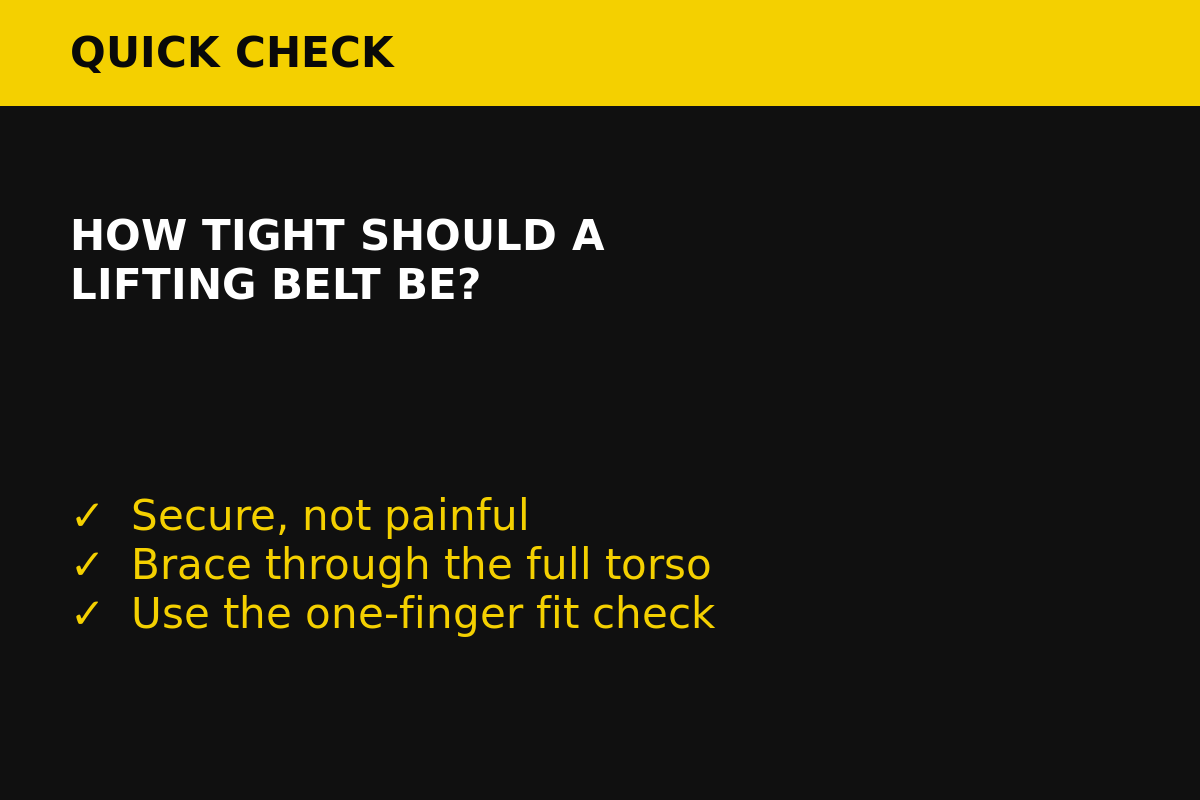
How tight should a lifting belt be? Tight enough that it stays in place and gives your torso a firm surface to brace against, but loose enough that you can take a full breath and expand your abdomen, sides and back. For many lifters, being able to slide one fingertip between the belt and the relaxed abdomen is a useful starting check—not an absolute rule.
Test tightness in the position where you lift. Stand, breathe into your abdomen and sides, then perform an unloaded squat or hinge. If you cannot expand against the belt or reach your normal start position, loosen it or adjust its height; if it shifts when you brace, try the next setting. The aim is repeatable pressure through the movement, not the tightest closure you can endure.
What Is Belt Tightness Actually For?
The purpose is not to compress the waist as much as possible. A lifting belt works best when you actively press the torso into it. That interaction can increase intra-abdominal pressure and help stiffen the trunk during a demanding lift. Research has recorded higher intra-abdominal pressure during lifting with a belt, although that does not mean a belt guarantees injury prevention. See the study abstract on PubMed.
Think of the belt as a wall. If the wall is too far away, you cannot create useful contact. If it is already crushing you, there is no room to expand. The correct tightness creates resistance after you inhale and brace.
Your setting may vary from day to day. A large meal, hydration, bodyweight change, clothing thickness and where you position the belt can all affect which hole or lever setting works.
Use the One-Finger Check as a Starting Point
- Place the belt around the area where you intend to lift.
- Fasten it while your abdomen is relaxed, not sucked in forcefully.
- Try to slide the tip of one finger between the belt and your body.
- Take a controlled breath into the lower torso.
- Brace outwards and confirm the belt becomes firmly loaded.
The finger test is only a quick screen. Soft nylon belts, thick leather belts and different body shapes will feel different. The decisive test is whether you can breathe, brace, reach the required lifting position and keep the belt from moving.
How to Brace Into the Belt
Do not simply push the stomach forward. Imagine the torso as a cylinder and expand around the whole circumference: front, sides and lower back. Keep the ribcage stacked rather than flaring dramatically, and create tension before the bar leaves the rack or floor.
A simple practice drill
Use an empty bar or moderate load. Put your hands on the sides of the belt. Inhale low and try to push both hands outward at once, then feel for pressure at the back of the belt as well. Hold the brace briefly, complete the repetition and reset.
If you cannot feel side pressure, loosen the belt one setting and practise again. If you feel pressure only where the buckle sits, check whether the belt is centred and level.
How Tight for Squats?
Many lifters prefer a firm belt setting for squats because the torso remains relatively upright compared with a conventional deadlift. The belt should not collide sharply with the bottom of the ribs or the top of the hips as you reach depth.
Before a heavy set, perform a bodyweight squat and an empty-bar squat. If the lower edge digs into the hip crease, move the belt slightly higher or change its angle. If the upper edge presses painfully into the ribs, try a slightly lower position, a narrower belt or one with a tapered front.
Your torso length matters. A four-inch belt that suits a tall lifter may occupy nearly all the space between the ribs and hips on a shorter torso.
How Tight for Deadlifts?
Deadlifts require a deeper hip hinge, so the same setting used for squats can feel restrictive. Some lifters loosen the belt by one hole, position it slightly higher or angle the front upward. Others use exactly the same setup. Test it rather than copying another person.
You must be able to reach the bar without the belt forcing the abdomen painfully into the thighs. If you lose your starting position because you cannot breathe or hinge, loosen or reposition it. A technically perfect-looking belt setting is useless if it prevents you setting up properly.
| Check | Squat | Deadlift |
|---|---|---|
| Can you take a full breath? | Required | Required |
| Does it pinch at full range? | Check at squat depth | Check in floor setup |
| Common adjustment | Firm, level position | Slightly looser or higher for some lifters |
| Test set | Empty bar and first warm-up | Light plate and first warm-up |
Signs Your Lifting Belt Is Too Tight
- You cannot inhale into the abdomen and sides.
- You feel sharp rib, hip or abdominal pinching before the set begins.
- Your legs or torso become numb or tingly.
- You cannot reach the required deadlift position.
- You feel light-headed because you are fighting the belt rather than controlling the breath.
- You have to suck in aggressively just to fasten it.
Brief pressure marks can occur with a stiff belt, but bruising, broken skin or significant pain is not a sign of a more effective setup.
Signs Your Lifting Belt Is Too Loose
- It rotates around the waist between repetitions.
- It slides towards the ribs or hips.
- Your brace does not make contact with the belt.
- The back panel shifts off-centre.
- The lever can close with almost no tension.
A loose belt sometimes still feels reassuring, but reassurance is not the same as useful feedback. Tighten one small increment and retest.
How to Adjust the Fit Systematically
Change one variable at a time. Start with the belt centred and level, then test tightness. If pinching remains, change height. If the lift still feels restricted, change the angle. Record the setting that works for each lift.
For a prong belt, note the hole. For a lever belt, mark or photograph the lever position before changing it. Lever belts are quick, but traditional fixed levers require a screwdriver to make larger adjustments. Your preferred setting may change during a bulk or cut.
Clothing affects the fit too. A thick hoodie or folded pump cover beneath the belt changes the circumference and can create pressure points. Wear the belt over a flat layer and pull excess fabric clear.
If you are deciding whether a belt is useful at all, start with our evidence-led guide: do weightlifting belts help? You can also view a leather belt for squats and deadlifts to compare construction and fastening.

Safety and Comfort
Do not wear a belt continuously for an entire gym visit. Release it between demanding sets so you can breathe and move normally. Stop if you experience pain, unusual shortness of breath, dizziness or numbness. People with relevant medical conditions should ask an appropriate healthcare professional whether heavy lifting and breath-holding strategies are suitable.
Frequently Asked Questions
Should a lifting belt leave marks?
Light temporary pressure marks can happen, particularly with stiff leather. Painful bruising or broken skin suggests the fit, position or belt choice needs changing.
Is the tightest setting the strongest?
No. Maximum compression can prevent you creating an effective breath and brace. The strongest setting is the one that stays secure while allowing expansion.
Should I use the same hole for squats and deadlifts?
Not necessarily. The deeper hinge in a deadlift makes a slightly different setting comfortable for many lifters.
Can I wear the belt over a hoodie?
You can, but thick folds change the fit and may create pressure points. A flat T-shirt layer is usually more predictable.
Why does my belt move upwards?
It may be too loose, too low, the wrong shape for your torso, or sitting over slippery fabric. Adjust one factor and retest with a light load.
Record Your Belt Settings
Once you find a workable setup, write it in your training log: belt model, hole or lever position, height, angle and whether it was used for squat or deadlift. Add a short comfort score after the set. This prevents every session becoming another round of guesswork and makes changes in bodyweight easier to manage.
Recheck the setting after washing bulky training clothes, changing exercise stance or gaining or losing several kilograms. A setting is not a permanent achievement. It is simply the current position that lets you breathe, brace and move well.
Final Takeaway
A lifting belt should feel secure before the repetition and firm once you brace, but it should never prevent a full breath or the position required by the exercise. Start with the one-finger check, practise against a moderate load and use separate settings for squats and deadlifts if that gives you better movement.
This article is general training information and is not medical advice.
SHOP OUR TOP GYM PRODUCTS
Mr Olympia Muscle-Fit Sweatshirt – Vintage Bodybuilding Top
£33.99Original price was: £33.99.£26.99Current price is: £26.99.Dorian Yates Bodybuilding Oversized Gym T-Shirt
Yujiro Hanma Gym Hoodie – Oversized Anime Pump Cover
£32.99Original price was: £32.99.£23.99Current price is: £23.99.Sam Sulek Certified Women Avoider T-Shirt – Cotton Gym Tee
Barbell Brigade Pump Cover – Bronze & Red Gym T-Shirt
Body Composition Scale with Handheld Sensor & 1.5 m Cable
£124.99Original price was: £124.99.£89.99Current price is: £89.99.Men’s Quick-Dry Gym Shorts – Muscle-Fit Training Shorts
Creatine Meme T-Shirt – Funny Gym Shirt for Men