



Do Weightlifting Belts Help? Benefits, Limits and When to Use One

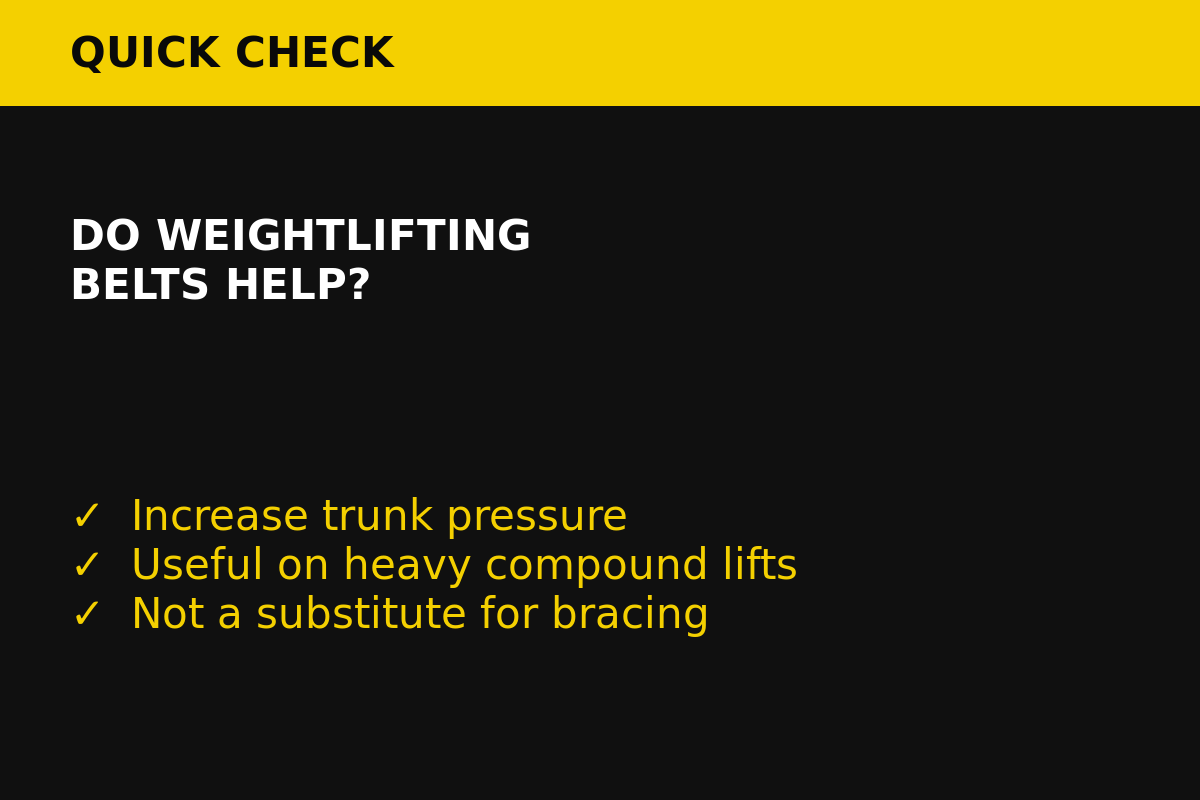
Do weightlifting belts help? They can. A properly fitted lifting belt gives your abdominal wall something to brace against, which may increase trunk pressure and make heavy squats, deadlifts and similar compound lifts feel more stable. Some lifters also move a given heavy load faster or complete more work while belted.
Try the same controlled movement at a manageable load with and without a belt. Notice whether you can breathe and brace all around the torso, keep your usual technique and set up consistently. A firmer feeling can be useful on hard working sets, but a belt that digs in or makes you rush the lift is not helping that session. Use the comparison to decide when the accessory earns a place in your training.
How Does a Weightlifting Belt Work?
A lifting belt wraps firmly around the torso. When you inhale and contract the muscles of your abdomen, sides and back, those tissues press outwards into the belt. The belt provides feedback and resistance, helping some people create a stronger 360-degree brace.
This is different from pulling your stomach in. A useful brace expands and stiffens the torso all the way around. Think about preparing to absorb a firm push: ribs stay controlled, the pelvis does not tip dramatically and the trunk becomes rigid before the lift begins.
The belt is not doing all the work. If you wear it loosely and do not brace, its effect will be limited. If you tighten it so aggressively that you cannot breathe into your abdomen, it can also undermine the technique you are trying to improve.
What Does Research Say?
Laboratory research has reported that belts can increase intra-abdominal pressure during lifting. One frequently cited study measured higher pressure during deadlift-style lifting when participants wore a belt; the full abstract is available through PubMed. Other research has examined movement speed, muscle activity and spinal loading, but results depend on the task, load, belt design and lifter.
The sensible conclusion is modest: a belt changes how the lift is performed and can improve a lifter’s ability to brace or produce force. That does not prove it prevents injury in every setting. Injury risk also depends on programming, fatigue, load management, exercise selection, previous injury and many factors a belt cannot control.
Potential Benefits of a Lifting Belt
Clearer bracing feedback
Many lifters understand “brace your core” more quickly when they can feel their trunk press into a firm surface. The belt gives immediate feedback: if you only push the abdomen forward, you will not feel equal pressure at the sides and back.
Confidence under heavy loads
Familiar equipment and a repeatable setup can make heavy sets feel more controlled. That confidence should come from practice, not from believing the belt makes you invulnerable.
Possible performance benefit
Some lifters can perform heavy repetitions with better speed or less perceived effort when belted. This is why belts are common in powerlifting and strength-focused bodybuilding. A small performance improvement can matter when the session includes demanding squats, deadlifts, rows or overhead presses.
Consistency across working sets
Placing the belt at the same height, using the same hole or lever setting and following the same breathing routine creates a consistent pre-lift ritual. Consistency makes technique easier to assess.
What a Belt Cannot Do
- It cannot fix an unsuitable programme. Too much load or fatigue remains too much load or fatigue.
- It cannot guarantee injury prevention. Be sceptical of absolute safety claims.
- It cannot replace rehabilitation. Persistent pain needs appropriate assessment, not tighter equipment.
- It cannot choose your technique. Stance, bar position, range of motion and exercise choice still have to suit you.
- It cannot build skill if you never practise. You must learn to breathe and brace deliberately.
A common mistake is treating the belt like a back support worn passively. A lifting belt is active equipment: it becomes useful when you deliberately press into it.
When Should You Use a Lifting Belt?
There is no universal percentage at which a belt becomes mandatory. Many lifters introduce it for heavier working sets—often when loads become challenging enough that trunk stiffness could limit the lift. Warm-up sets can remain beltless until you approach the load at which you intend to use it.
| Situation | Belt? | Reason |
|---|---|---|
| Light technique practice | Usually optional | Good opportunity to practise control without equipment |
| Heavy squat or deadlift set | Often useful | May improve bracing feedback and performance |
| Machine isolation exercise | Usually unnecessary | External stability and lower trunk demand |
| Set performed through pain | No | A belt should not be used to override warning symptoms |
| Competition-specific training | Use as permitted | Practise with the equipment you will compete in |
Bodybuilders may use belts selectively on their most demanding compound sets while leaving accessory work beltless. Powerlifters are more likely to practise the exact belt setup used in competition. Neither approach is automatically superior; the equipment should match the goal.
How to Brace Into a Lifting Belt
- Place the belt around the part of your torso that lets you squat or hinge without pinching your ribs or hips.
- Fasten it firmly while leaving enough room to take a full breath.
- Inhale low into the torso rather than lifting the shoulders.
- Expand the abdomen, sides and lower back against the belt.
- Hold that pressure as you begin the repetition, then reset your breath safely between repetitions.
Practise with a moderate load. A heavy personal best is the wrong time to discover that the belt sits too low, catches the ribs or prevents you reaching your start position.
Choosing the Right Belt
Four variables matter: width, thickness, material and fastening. A consistent-width leather powerlifting belt feels very rigid and provides a large surface to brace against. A tapered leather belt can offer more room near the ribs. Nylon belts are lighter and more flexible. Lever closures are quick and repeatable; prong belts are easier to adjust when your waist measurement changes.
The stiffest option is not automatically best. A smaller lifter, a person with little space between ribs and hips, or someone mainly using the belt for bodybuilding may prefer a narrower or more flexible design.
You can compare designs in The Gym Pro’s powerlifting belt range. Check the product’s actual waist measurements and measure where you will wear the belt, not where your trousers sit.

Common Belt Mistakes
- Pulling the belt as tight as possible instead of leaving space to brace.
- Wearing it at one fixed height for every lift even when it pinches.
- Using it for every exercise regardless of trunk demand.
- Believing beltless lifting is always “functional” and belted lifting is cheating.
- Adding load immediately because the first belted set feels stable.
Frequently Asked Questions
Do lifting belts weaken your core?
Using a belt does not switch off the trunk muscles. You still have to brace actively. Keeping some beltless warm-ups or accessory work can help you maintain both skills.
Will a belt stop lower-back pain?
Not reliably. Do not use a belt to diagnose or treat pain. Modify the aggravating movement and seek professional advice if symptoms persist or worsen.
Are belts only for powerlifters?
No. Bodybuilders, weightlifters and recreational gym users can use them on demanding compound lifts. They are optional, not a badge of experience.
Should I wear a belt for rows or overhead press?
You can if trunk stability limits a heavy set, but many people do not need one. Judge it by whether the belt improves position and performance.
Can beginners use a lifting belt?
Yes, once they understand basic breathing and bracing. A beginner should learn what the belt is doing rather than fastening it blindly.
A Two-Week Belt Trial
To judge whether a belt helps you, keep the programme unchanged for two weeks. Use it on the same squat or deadlift sets, record load, repetitions, estimated effort and any technique notes, and compare them with recent beltless sessions. The first workout may feel unusual, so avoid judging from one set.
A useful belt should make bracing more repeatable or performance more confident without introducing pain or changing the movement for the worse. If nothing improves after several properly practised sessions, you do not have to force it into the programme. Equipment earns its place by solving a real problem.
Repeat the comparison after several sessions, because learning the belt can improve the result independently of the equipment itself. Record the same lift under similar fatigue.
Final Takeaway
Weightlifting belts can help by improving bracing feedback, trunk pressure and performance during demanding lifts. Their benefit is real but limited. Use a belt deliberately, keep load progression sensible and remember that good training decisions matter more than any single piece of equipment.
This article provides general training information and is not medical advice.
SHOP OUR TOP GYM PRODUCTS
Smart Body Composition Scale – Bluetooth LCD Fitness Tracker
£38.99Original price was: £38.99.£29.99Current price is: £29.99.Mr Olympia Winter Hat – Thermal Bodybuilding Beanie
£28.99Original price was: £28.99.£21.99Current price is: £21.99.No Pain No Gain Weightlifting Belt – Heavy-Duty Support
£32.99Original price was: £32.99.£26.99Current price is: £26.99.I’m Afraid of Women Gym Retro T-Shirt – Funny Bodybuilding Tee
Demon Oni Weightlifting Belt – Unisex Powerlifting Support
Berserk Muscle-Fit Gym T-Shirt – Anime Workout Tee
Joe Weider 1965 Mr Olympia T-Shirt – Oversized Pump Cover
£30.99Original price was: £30.99.£21.99Current price is: £21.99.Mike Mentzer Clothing – Uncrowned King Cotton T-Shirt