


How to Adjust a Lever Lifting Belt Before Training
A lever belt feels wonderfully simple once it is set correctly: close the lever and you get a familiar fit. The first adjustment can be less obvious, especially when your waist measurement falls between positions. Here is a careful way to adjust a lever lifting belt without turning the first heavy set into the test.
Lever mechanisms vary. Read the maker’s instructions for your exact belt before moving the hardware. Some use screws to relocate the lever, while other designs allow quicker adjustments. Never assume a diagram for one model applies to another.
Find your starting position
Measure around your midsection where you plan to wear the belt, usually somewhere between the hips and ribs. Compare that number with the size chart on the product page rather than using your trouser waist. Put the belt around you without lifting anything. Note where the lever meets the receiving holes and whether there is adjustment room in both directions.
Our belt measurement guide explains why the training position matters. If the belt’s size range does not accommodate you, a different belt size is a better answer than forcing a closure.
Set the lever in a controlled sequence
- Place the belt on a stable surface and inspect the lever, screws and holes. Stop if a part looks cracked or bent.
- Follow the manufacturer’s method for releasing the hardware. Keep screws and any washers together, and use the correct tool.
- Move the lever one setting rather than making a large jump. Align all intended fixing points and refit the hardware according to its instructions.
- Check that the fasteners are properly seated. Do not guess at a torque value that the maker has not specified.
- Put the belt on while standing, close the lever carefully and test your breathing and unloaded movement.
Repeat the process if the setting is clearly wrong. Do not adjust screws with the belt under tension around your body. A maker’s own product instructions are the appropriate reference for its specific hardware; this checklist is a general sequence.
Test fit before you load the bar
A secure belt should give your abdomen a surface to push against when you brace without preventing a useful breath. Stand, breathe, squat to a comfortable depth and hinge as you would for a deadlift. If the top edge digs sharply into your ribs or the bottom edge catches on your hips, experiment with placement. If it still interferes, the belt’s width or size may be wrong for you.
Then work through your normal warm-up sets. Notice whether the closure stays secure and whether you can repeat your starting position. Belt tightness is personal within a functional range: “as tight as possible” is not a useful instruction. Our tightness guide explains the bracing check in more detail.
| What you notice | Check first |
|---|---|
| You cannot take a useful breath | Try one looser setting or a slightly different position. |
| The belt slides during setup | Check size, closure and placement before adding load. |
| Lever does not close normally | Stop; inspect the mechanism and its alignment. |
| Ribs or hips are pinched | Check belt width and torso clearance. |
When the problem is the belt size, not the lever
A lever cannot make an incorrectly sized belt fit every body shape. If the adjustment is at its last position and the belt remains loose or uncomfortably tight, revisit the size chart. If your waist changes substantially during a training cycle, expect to revisit the setting. A prong closure may suit someone who wants to change tightness frequently without moving hardware; see the lever-versus-prong comparison.
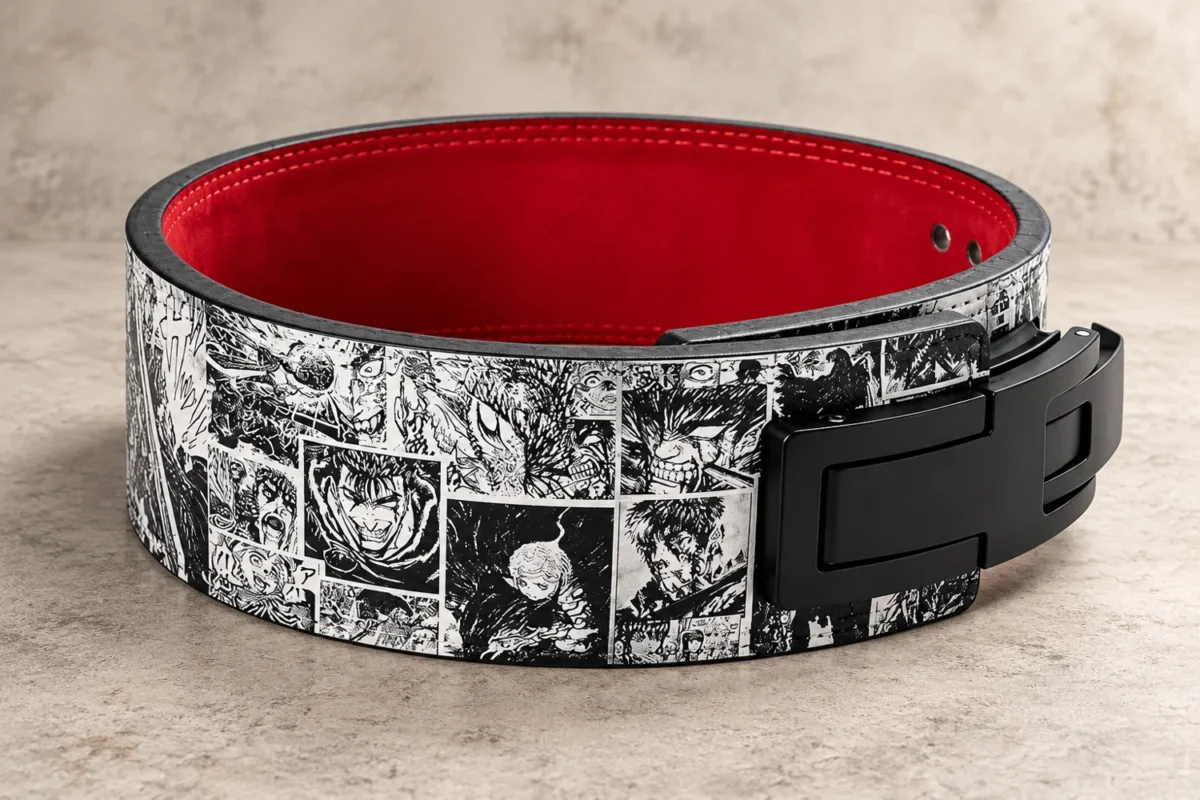
Our Berserk lever belt is an in-stock option for lifters who want anime artwork. Check its live size and variation choices before ordering; this article is not a substitute for its model-specific setup details. For a different style, browse our gym accessories.
Set the fit with the clothing you normally wear
A thin training tee, thick hoodie and bare waist can make the same lever setting feel different. Choose the setting while wearing a typical lifting outfit. If you train in several layers during warm-ups, consider how the belt will sit once the outer layer comes off. Do not close it over folded fabric that bunches under the buckle.
Check that you can use the belt in the positions you care about. An unloaded squat and deadlift setup reveal different points of contact with your ribs and hips. A setting that feels ideal standing upright might be too restrictive as you reach the bar.
How to keep the adjustment repeatable
Make a note of the lever position that worked and the outfit you tested it with. If you move the hardware later, record the new position and reason. Take an unloaded fit check before loading the bar. If the mechanism has more than one fixing point, check all of them according to the maker’s instructions. Do not improvise replacement screws because they appear to fit.
A lever is convenient because it returns to a familiar closure, but the repeatability only helps if the underlying belt size is right. If you must pull with excessive force to shut it, revisit the setting. If it closes effortlessly and shifts during the warm-up, check whether it is too loose or positioned incorrectly.
When to stop and inspect
If the lever opens unexpectedly, the belt slips, or you see cracks or loose stitching, stop using it under load. Inspect the hardware and contact the seller or maker if necessary. The remedy is not to push harder on the lever and hope it holds. A secure closure is a basic requirement before any heavy attempt.
Common questions
Should I use the same setting for every lift?
Some lifters do, while others prefer a little more breathing room for a hinge. Test each movement unloaded and during warm-ups; do not make a drastic change just before a maximal attempt.
What if a screw keeps loosening?
Stop using the belt under load and follow the maker’s service advice. Repeatedly closing a questionable lever is not a sensible test.
Does a belt replace bracing practice?
No. Learn to create pressure around your midsection and control the movement. The belt is a tool to brace against, not a shortcut to technique.
Before the next heavy set: Confirm the lever is seated, the hardware is sound, and the fit works through your actual lifting position.
SHOP OUR TOP GYM PRODUCTS
No Pain No Gain Weightlifting Belt – Heavy-Duty Support
£32.99Original price was: £32.99.£26.99Current price is: £26.99.I’m Afraid of Women Gym Retro T-Shirt – Funny Bodybuilding Tee
Berserk Lever Belt – Anime Powerlifting Gym Belt
£84.99Original price was: £84.99.£69.99Current price is: £69.99.Ronnie Coleman T-Shirt – Funny Bodybuilding Gym Tee
Mike Mentzer Clothing – Uncrowned King Cotton T-Shirt
Berserk Gym Belt – Weightlifting Belt for Men & Women
Kevin Levrone Uncrowned T-Shirt – Cotton Gym Pump Cover
Creatine Meme T-Shirt – Funny Gym Shirt for Men