



12-Week Bodybuilding Plan: Checkpoints at Weeks 1, 4, 8 and 12
Week one of a new programme feels clear: you have a plan and a reason to train. By week four, normal fluctuations can make you doubt it. A 12-week bodybuilding plan becomes easier to follow when you decide in advance what to review and when, rather than rewriting it after every flat workout.
These four checkpoints work with any sensible plan. They do not promise a particular change in bodyweight or appearance. If you are using our paid Olympian Sculpt 12-week bodybuilding e-book, treat the guide below as a way to monitor your response, not as a claim about unlisted features of the download.
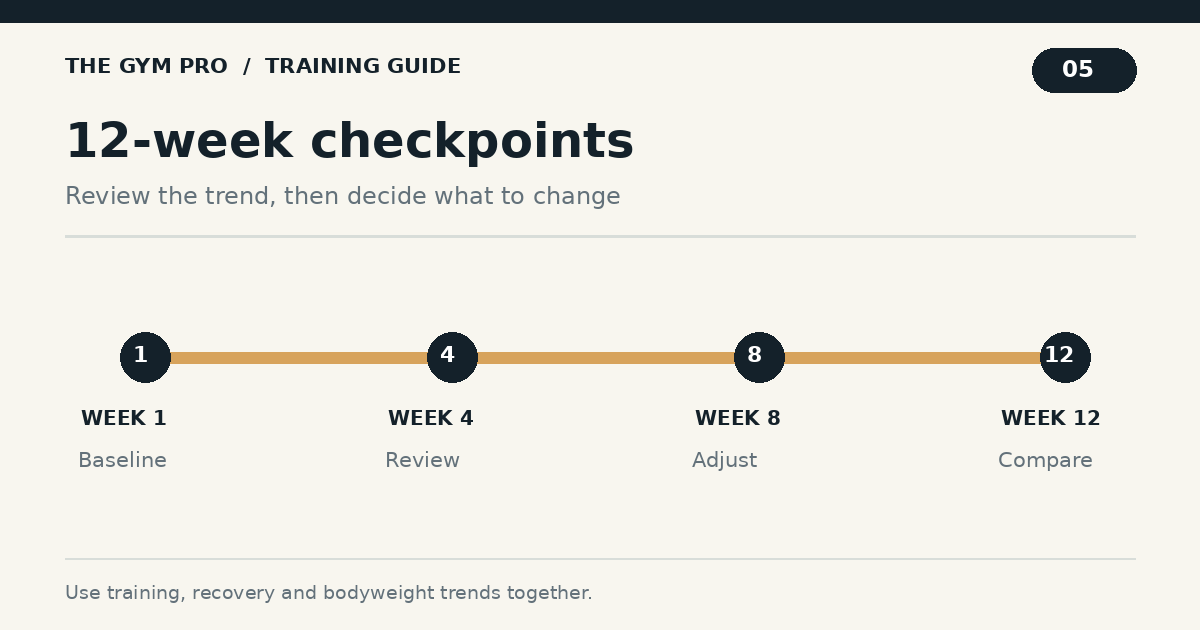
Week 1: build a baseline you can repeat
Write down the plan’s exercise selection, training days and working weights. Record sets, reps, approximate effort and any technique note that will help you repeat a lift. Use the same scale, time of day and conditions for bodyweight if you decide to track it. Optional photos should use similar lighting, distance and pose. You can also measure waist, chest or limbs, but do not collect more numbers than you are willing to review.
Start conservatively enough to learn the movements. A first week filled with all-out sets may give you impressive soreness but poor information about what you can repeat. Read the RIR and RPE guide if you need a simple effort scale.
Week 4: check adherence before judging results
Count completed sessions. If you planned four per week and managed two, changing exercises is unlikely to solve the main problem. Adjust the calendar or choose a lower-frequency plan. If attendance is good, compare a few repeated exercises under similar conditions. More reps at the same weight with the same range of motion is a useful sign even when your mirror has not changed.
Now look at recovery. Are you still unusually sore when the same muscle is due to train? Has fatigue stayed high across several sessions? If so, examine total weekly work and rest before adding more. The ACSM’s updated training guidance stresses regular participation and tailoring training variables to individual goals.
Week 8: adjust one thing at a time
If performance is improving and you can recover, keep going. A working plan does not need an overhaul because a different exercise is popular online. If one lift has stalled for multiple comparable sessions, check technique, rest time and whether you have allowed enough opportunities to improve within its rep range. Then consider a small change: a different load, one fewer set, or a better-fitting exercise. Changing all three at once makes it harder to learn what helped.
If your goal is to gain muscle and bodyweight is dropping steadily, examine food intake before blaming the split. If your goal is to lose fat while retaining muscle, compare strength trends alongside weight rather than treating the scale as the only result. Our smart-scale guide explains why a daily body-fat percentage deserves caution. A body-composition scale can help you record a trend, not diagnose your progress on its own.
Week 12: decide what happens next
Review attendance, performance, recovery and optional measurements together. Ask: Which exercises improved? Which sessions were consistently missed? Which choices made training easier to sustain? Repeat the same plan with updated loads if it still fits, or change the structure if your schedule or goals have changed. A new twelve-week cycle does not require a completely new identity.
| Checkpoint | One useful question | Next action |
|---|---|---|
| Week 1 | Can I repeat this setup? | Log the baseline. |
| Week 4 | Did I actually follow the schedule? | Fix attendance before exercises. |
| Week 8 | What has improved or stalled? | Change one variable if needed. |
| Week 12 | What should I keep next cycle? | Repeat or adapt the plan. |
Use several measures, not one dramatic number
Training log entries tell you about performance. Bodyweight trends can tell you about energy balance, but water, food and timing affect the daily reading. Photographs and measurements can add context if taken consistently. None of these guarantees a specific amount of muscle gain. If you have health conditions or a history of disordered eating, discuss body-measurement practices with an appropriate professional.
Want a free starting point before choosing a paid plan? The 7 Gym Commandments introduces principles inspired by Mike Mentzer. To see an example of making the next set a little better, read our progressive overload guide.
A simple checkpoint worksheet
At each review, write four short answers: sessions planned/completed; one exercise that improved; one obstacle; one change for the next block. Example: “Planned 16 sessions, completed 14; pulldown rose from 8 to 11 controlled reps at the same load; late meetings disrupted Fridays; move Friday training to Saturday.” That is a plan you can act on. “I need more motivation” is much harder to use.
Choose a handful of repeated exercises rather than comparing every movement. A squat-pattern lift, a press and a pull can reveal whether training is moving. If you changed machines, grip, depth or rest, mark that change. A new exercise is a new baseline, not proof you suddenly got stronger or weaker.
When measurements disagree
Suppose bodyweight is unchanged but your repeated sets are improving. You may still be making worthwhile training progress; do not dismiss it because the scale is flat. Suppose bodyweight rises quickly but performance and recovery are poor. A higher number is not proof of more muscle. Sleep, food, menstrual cycle, hydration and travel can all affect the day-to-day picture. Use comparable conditions and multiple weeks.
For someone focused on general fitness rather than a physique target, attendance and movement quality may be enough. You do not have to take progress photos or track every measurement to justify training.
Decide in advance what would change your plan
Write down a trigger: perhaps repeated technique breakdown, several weeks of performance decline across more than one lift, or a schedule that you cannot keep. Then choose a modest response—reduce work, change the day, or substitute a troublesome exercise. This keeps one bad workout from becoming an impulsive programme overhaul.
At the end of week twelve, keep the parts that worked. A second cycle can be more effective simply because you understand the exercises and your schedule better. Start the next block with that information instead of wiping the slate clean.
Questions people ask
Should I change the programme after one bad workout?
Usually no. Compare several similar sessions and include sleep, food and stress in the picture.
Do progress photos matter?
They are optional. If you use them, keep pose and lighting similar and judge a series rather than two pictures taken on very different days.
The practical aim: By week twelve you should know what was repeatable, what improved and what to change next, even if the visual result was slower than you hoped.
SHOP OUR TOP GYM PRODUCTS
Dorian Yates Bodybuilding Oversized Gym T-Shirt
Mr Olympia Muscle-Fit Sweatshirt – Vintage Bodybuilding Top
£33.99Original price was: £33.99.£26.99Current price is: £26.99.Milk Makes My Tummy Hurt T-Shirt – Funny Gym Pump Cover
Joe Weider 1965 Mr Olympia T-Shirt – Oversized Pump Cover
£30.99Original price was: £30.99.£21.99Current price is: £21.99.Creatine Meme T-Shirt – Funny Gym Shirt for Men
Mr Olympia Hoodie – 2020 Zip-Up Bodybuilding Jacket
No Pain No Gain Weightlifting Belt – Heavy-Duty Support
£32.99Original price was: £32.99.£26.99Current price is: £26.99.Mr Olympia Winter Hat – Thermal Bodybuilding Beanie
£28.99Original price was: £28.99.£21.99Current price is: £21.99.