



Bodybuilding Workout Log: What to Record and How to Use It
You finish a workout, remember that your rows felt hard, and then spend the next week guessing which weight you used. A bodybuilding workout log fixes that small but expensive problem. It gives your next session a starting point and helps you notice whether your programme is working across weeks, not just on one good Monday.
You do not need an elaborate app. A note on your phone or a small notebook will do. The trick is to record details you can use. Here is a practical logbook method for lifters focused on muscle growth.
Record five things for each exercise
- Exercise and setup. “Seated cable row” is less useful than “seated cable row, neutral handle, second pin.” Machine stacks and bench angles change the numbers.
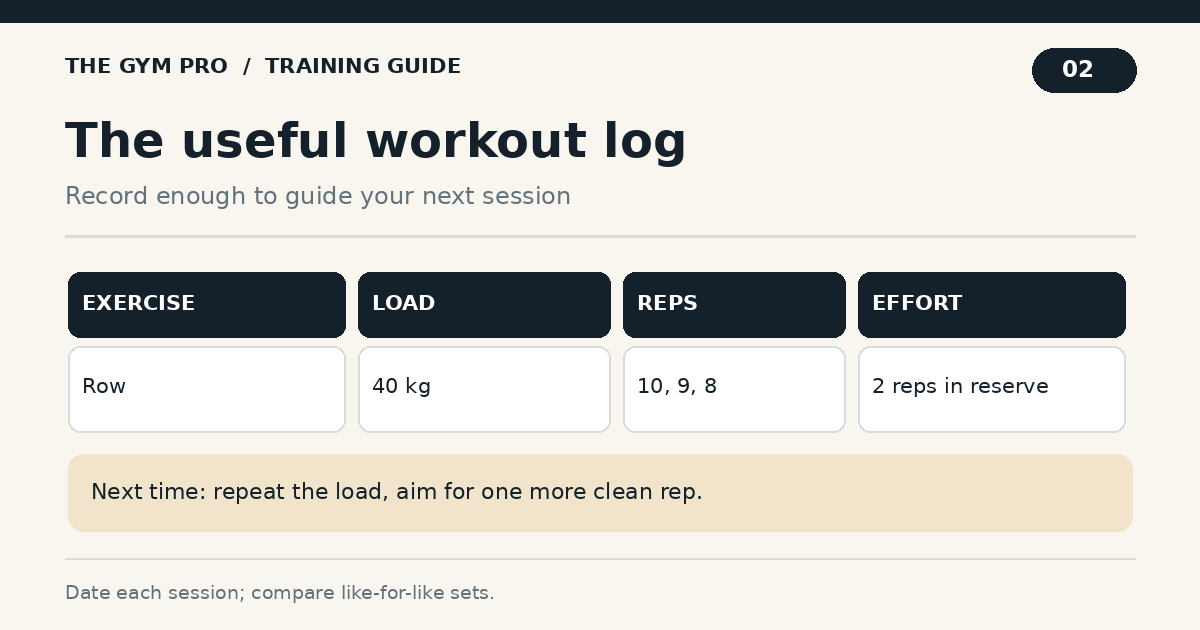
- Working weight and reps for every set. Record 30 kg × 11, then 30 kg × 9 rather than “two sets of 10.” The drop may tell you something about fatigue and rest.
- Effort. Add a short note such as “about two reps left” or “last rep slow.” Use the RIR/RPE guide if you want a consistent scale.
- Rest and technique when they matter. If you rest one minute this week and three minutes next week, a rep increase has a different meaning. “Depth shortened on last two reps” matters more than a flattering number.
- A next-session instruction. “Repeat 30 kg and aim for 12, 10” is useful. “Work harder” is not.
Warm-up sets can sit in a separate line. Compare working sets under similar conditions. If you swap a machine for a dumbbell version, label it as a different exercise instead of pretending the loads are interchangeable.
Example: turn numbers into a decision
| Week | Movement | Working sets | Next time |
|---|---|---|---|
| 1 | Machine chest press, seat 4 | 40 kg × 10, 40 kg × 9 | Keep 40 kg, aim for 10 + 10 |
| 2 | Same setup | 40 kg × 11, 40 kg × 10 | Aim for 12 + 12 |
| 3 | Same setup | 40 kg × 12, 40 kg × 12 | Increase one small step |
These are illustrative numbers, not targets. The decision follows from the record. Once the top of a rep range is repeatable with the same technique, you can add a little load. If the new weight brings reps down, work through the range again. Our progressive overload guide explains this method.
Review the pattern every four weeks
Look at comparable sessions. Are reps, load, range of motion or control improving? One rough workout after bad sleep does not make a plateau. A month of stagnant performance across several movements warrants a closer look at food, recovery, technique and how much work your plan asks of you. The ACSM’s updated resistance training guidance puts regular participation ahead of unnecessarily complex programming for most healthy adults.
If body composition matters, keep a separate weekly note for bodyweight trends, optional measurements and photographs taken in similar conditions. A single reading on a smart body-composition scale is not a verdict on muscle gain; hydration and timing can move estimates. Read our smart-scale guide before treating one percentage as a result.
Your log can reveal a different kind of progress, too. Perhaps a weight that previously needed a spotter now moves smoothly. Perhaps you finish the same session with fewer unnecessary warm-up sets. Record those observations. They are useful even when the scale does nothing exciting.
Four mistakes that make a log less useful
- Only writing the heaviest set. The other sets show whether you can sustain useful work.
- Recording the numbers after getting home. Write them between sets so memory does not round everything up.
- Changing five variables at once. Keep a movement and setup for long enough to tell whether you are progressing.
- Treating every session as a test. Hard work is valuable, but chasing a personal best on every accessory lift makes technique and recovery difficult to judge.
A copyable workout-log template
Use one line per exercise in a notes app: Date | exercise and setup | warm-up | set 1 load × reps | set 2 load × reps | effort | next time. Example: “19 Oct | neutral-grip pulldown, seat 3 | 20 kg × 8 | 35 kg × 11 | 35 kg × 10 | about 2 reps left | keep 35 kg and aim for 12/11.” You can add rest if it changed significantly. This is more informative than an app full of graphs that you never consult.
If you train at two gyms, add the gym name. A “40 kg” cable stack can feel different between machines. If you switch grip or adjust the seat, mention that as well. The aim is not laboratory precision; it is a fair comparison with the last similar session.
Separate performance from body changes
A log of weights and reps answers: “Am I doing more useful work with the same setup?” It does not directly measure muscle tissue. A bodyweight trend answers a different question and can move for reasons unrelated to muscle. Clothing fit, waist measurements and consistent photos may add context, but each has limitations. Review them together at a set interval rather than after every workout.
If you have a week with lower reps, write down the context—less sleep, illness, different equipment, a shorter rest—and keep going. The next comparable session may return to normal. If the trend remains down for several weeks, check whether the plan’s volume, nutrition and recovery still fit your life.
When to update the plan
Give your main exercises time to produce comparable entries. If an exercise causes repeated discomfort or cannot be performed with control, change it sooner and record the substitution. If performance improves, you do not need to change the routine simply because a new online split looks more exciting. A useful plan and a useful log work together: one sets the direction, the other checks reality.
Common questions
Do I need to log every isolation exercise?
Log anything you actively want to progress. If time is tight, start with four or five key movements. Add more when the habit sticks.
What if I miss a week?
Return to your last comparable entry, choose a sensible starting load and record a new baseline. Missed sessions are not a debt to repay in one workout.
Can a programme replace a log?
They do different jobs. A programme tells you what to do; the log tells you how you responded. The paid Olympian Sculpt 12-week bodybuilding e-book gives a structured framework. The free 7 Gym Commandments introduces training principles. Check each page for what it includes.
Try this: Before your next session, write your exercises in a note with space for sets, reps and one honest observation. Next week you will have something useful to compare.
SHOP OUR TOP GYM PRODUCTS
No Pain No Gain Weightlifting Belt – Heavy-Duty Support
£32.99Original price was: £32.99.£26.99Current price is: £26.99.Powerhouse Gym Cap – Classic Denim Unisex Bodybuilding Hat
£26.99Original price was: £26.99.£15.99Current price is: £15.99.Mr Olympia T-Shirt – Joe Weider Oversized Bodybuilding Tee
Berserk Gym Belt – Weightlifting Belt for Men & Women
Milk Makes My Tummy Hurt T-Shirt – Funny Gym Pump Cover
Powerhouse Gym T-Shirt – Vintage Oversized Washed Cotton
Mr Olympia Muscle-Fit Sweatshirt – Vintage Bodybuilding Top
£33.99Original price was: £33.99.£26.99Current price is: £26.99.Dorian Yates Bodybuilding Oversized Gym T-Shirt