


Dumbbell-Only Workout Plan: Three Days to Build Muscle
This dumbbell-only workout plan uses two full-body sessions alternated across three non-consecutive days. It covers squatting, hinging, pressing, rowing and smaller muscle groups without requiring a barbell or a large collection of machines.
Limited equipment becomes a real problem only when you stop finding a way to make the same movement harder. If your heaviest dumbbells become easy for a bilateral squat, a controlled split squat may keep the legs challenged. Record reps and form before adding complexity. This three-day plan gives each session a purpose and leaves room to adapt a movement when the available weights or bench do not suit it.
Dumbbell-only workout plan: the weekly schedule
Train on Monday, Wednesday and Friday, or another arrangement with recovery between sessions. In week one, perform A, B, A. In week two, perform B, A, B, then repeat that pattern. This balances the two sessions across a fortnight.
If you can train only twice a week, perform A and B once each. Do not cram missed sessions into consecutive days simply to preserve the written calendar. Consistent attendance at a manageable frequency is more valuable than repeatedly overloading a busy week.
Begin with two working sets per exercise if you are new or returning. The tables show the fuller version to build towards when appropriate. Warm-up sets are additional. Keep a record of the weight in each dumbbell rather than switching between combined and per-hand numbers.
Workout A: squat, press and row
| Exercise | Working sets | Repetitions |
|---|---|---|
| Goblet squat | 3 | 8–12 |
| Dumbbell bench press or floor press | 3 | 8–12 |
| Supported one-arm row | 3 per side | 8–15 |
| Dumbbell Romanian deadlift | 2 | 8–12 |
| Dumbbell lateral raise | 2 | 12–20 |
| Dumbbell curl | 2 | 10–15 |
Rest around two minutes for the more demanding movements and roughly a minute or more for smaller exercises, extending rest when needed to preserve quality. Three sets per side on a row mean each side receives three sets.
Keep the first exercises as the priority when time is short. If the full session is too long, use fewer sets or omit an optional isolation exercise rather than rushing every movement. The plan should fit the time you can actually repeat.
Workout B: single-leg work and overhead pressing
| Exercise | Working sets | Repetitions |
|---|---|---|
| Split squat | 3 per leg | 8–12 |
| Dumbbell overhead press | 2–3 | 8–12 |
| Chest-supported or supported one-arm row | 3 | 8–15 |
| Dumbbell glute bridge | 2 | 10–15 |
| Comfortable dumbbell triceps extension | 2 | 10–15 |
| Supported calf raise | 2 | 12–20 |
For unilateral work, train the less capable side first and match controlled repetitions where appropriate. Do not force a painful movement to satisfy the table. A stable support can help balance during split squats and calf raises.
If overhead pressing is uncomfortable, choose an appropriate pressing alternative with guidance rather than pushing through pain. Exercise substitutions should preserve the broad purpose while fitting your body and equipment.
Set up the main lower-body movements
For a goblet squat, hold the dumbbell securely close to your torso and choose a stance that lets you descend comfortably. Keep pressure through the feet and use a depth you can control. Do not force a particular stance because it looks identical to someone else’s.
For a Romanian deadlift, start upright with the dumbbells close to your thighs. Move the hips back with a small, reasonably stable knee bend, lowering only as far as you can maintain control. Stand by bringing the hips forwards rather than leaning backwards at the top.
A split squat keeps the feet in a staggered stance while you lower and rise. Begin with bodyweight and a support if balance is difficult. A rear-foot-elevated version is optional, not mandatory. Our squat-depth guide helps you choose a controlled range without chasing arbitrary depth at the expense of stability.
Presses and rows: choose stable versions
Use a sturdy exercise bench for bench pressing, with a load you can get into and out of position safely. If you do not have a suitable bench, a floor press is a practical alternative. The floor limits the bottom range, so treat it as its own exercise when tracking progress.
For a one-arm row, support yourself on appropriate stable equipment and keep the torso reasonably still. Pull the upper arm back without twisting to throw the dumbbell upwards. Let the shoulder move naturally within a comfortable range.
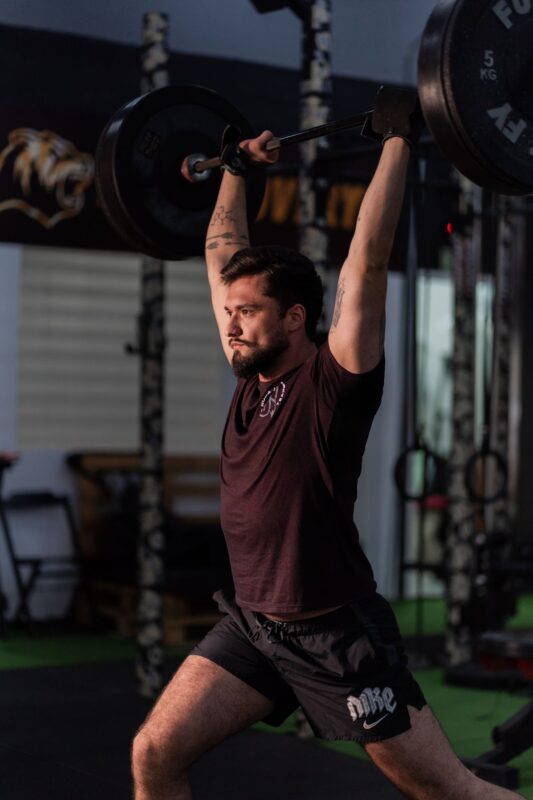
For overhead pressing, begin with a manageable load and avoid turning every repetition into a large back bend. A seated version may make the setup easier for some lifters. If the weights are too heavy to position safely, they are not appropriate working weights for your current setup.
How to choose loads and effort
Use the first week to establish a baseline. Choose weights that let you reach the lower end of the target range with a few clean repetitions still available. The final repetition should resemble the first in its basic movement pattern.
If you can easily exceed the top of the range, increase the load next time. If you cannot reach the lower target without swinging, twisting or shortening the movement substantially, reduce it. You do not need to discover an exact maximum before the programme can begin.
Our RIR and RPE guide explains effort estimates. They are approximate tools, especially for beginners. Start conservatively and learn from repeat sessions rather than taking every exercise to failure in an attempt to make the estimate precise.
Double progression with a worked example
Keep the weight stable while building repetitions. For a press with an 8–12 range, a result of 10, 9 and 8 is a baseline. Over later sessions, try to add a controlled repetition somewhere in the three sets.
Once you can complete all sets at the upper target with the intended effort and technique, try the smallest available weight increase. It is normal for repetitions to fall towards the lower end again.
| Example exposure | Result | Decision |
|---|---|---|
| 1 | 10 / 9 / 8 | Keep the load |
| 2 | 11 / 10 / 9 | Keep building repetitions |
| Later exposure | 12 / 12 / 12 | Try the next sensible increment |
The example is illustrative, not a promised rate of progress. Our progression guide covers the same method in more detail, including what to do when equipment jumps are large.
When your dumbbells become too light
First use the available repetition range and make sure the movement is controlled. Then consider a suitable single-leg or single-arm variation where it changes the challenge productively. A split squat can make a modest lower-body load more demanding without requiring an unstable setup.
You can also add a brief pause or choose a harder leverage, but record the change as a new variation. Do not compare its repetitions directly with the easier version as though nothing changed. Extremely slow repetitions are not an unlimited substitute for additional resistance.
Eventually, equipment can become the constraint. If your legs can do far more than the heaviest goblet squat allows, you may need heavier adjustable dumbbells, different appropriate equipment or gym access. A dumbbell-only plan is versatile, but it does not make every load sufficient forever.
Bench-free substitutions and practical limits
Use a floor press instead of a bench press, a glute bridge instead of a bench-supported hip thrust, and a supported row using genuinely stable equipment. Do not improvise a bench from unstable chairs or furniture that cannot support the task.
A dumbbell-only setup also lacks a straightforward heavy vertical pull. Rows provide useful pulling work, but they are not identical to pull-ups or pulldowns. If you later gain access to a secure bar or cable machine, you can expand the exercise menu thoughtfully.
For home training, clear enough floor space to place the weights down safely and check adjustable dumbbell locks before each session. Equipment handling is part of the workout. Avoid finishing a set so exhausted that you cannot return the weights safely to the floor.
Review the plan after a training block
After several consistent weeks, review attendance, exercise comfort, performance and recovery. Keep the movements that are progressing and change only those with a clear problem. A programme does not need to become more complicated simply because it is no longer new.
Support the training with regular meals and sleep. Our protein guide gives food-based examples, while the recovery guide helps you review fatigue.
Can beginners use this plan?
Yes, with lighter loads, fewer initial sets and suitable technique guidance. The fuller table is something to adapt, not a required first-session workload.
Can I add abs?
A small amount can fit after the main work if recovery and time allow. Use our core workout rather than adding a long daily circuit by default.
Do I need extra sessions?
Not unless the current schedule is consistent and there is a clear reason. Improve the quality of the sessions you can repeat before expanding the week.
For adjustable dumbbells, allow time between exercises to change both handles and check that the locking mechanism is secure. Write the required load beside each movement before the session so you are not recalculating it while tired. If changing plates makes supersets awkward, perform ordinary straight sets instead. Saving a minute is not worth rushing the setup or leaving one side loaded differently by mistake. A simple equipment checklist makes home sessions more reliable.
SHOP OUR TOP GYM PRODUCTS
Ronnie Coleman T-Shirt – Funny Bodybuilding Gym Tee
Loose Bodybuilding Trousers – Hardcore Gym Workout Pants
Berserk Lever Belt – Anime Powerlifting Gym Belt
£84.99Original price was: £84.99.£69.99Current price is: £69.99.Mr Olympia T-Shirt – Joe Weider Oversized Bodybuilding Tee
Mike Mentzer T-Shirt – Heavy Duty Muscle-Fit Cotton Tee
Mr Olympia Winter Hat – Thermal Bodybuilding Beanie
£28.99Original price was: £28.99.£21.99Current price is: £21.99.Body Composition Scale with Handheld Sensor & 1.5 m Cable
£124.99Original price was: £124.99.£89.99Current price is: £89.99.Berserk Gym Belt – Weightlifting Belt for Men & Women