



High-Intensity vs High-Volume Training: How to Choose
One lifter swears by a brief all-out set. Another logs several hard sets for each muscle and says volume is the answer. If you are comparing high-intensity vs high-volume training, the useful question is not which camp has the louder advocate. It is which amount of work you can perform well, recover from and repeat.
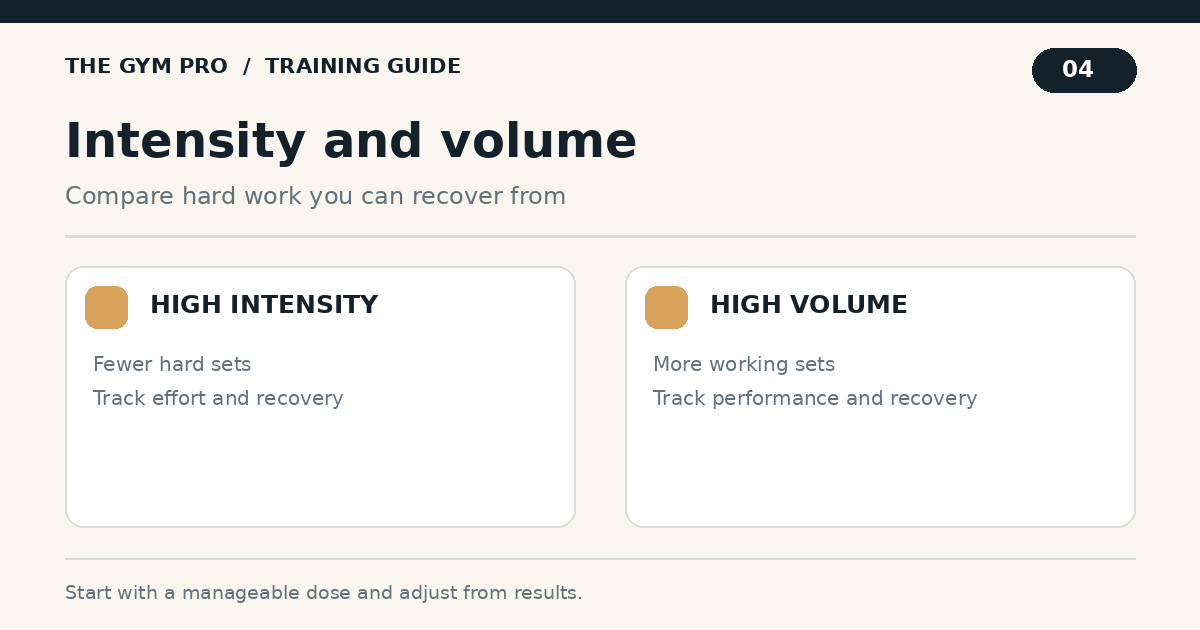
“Intensity” can mean load, effort or simply how hard a workout feels, so start with clear terms. Here, high-intensity training (HIT) means a smaller number of hard working sets, often pushed close to muscular failure. Higher-volume training means more working sets spread over the week. A programme can include both demanding sets and moderate volume; these are not rigid teams.
What actually changes between the approaches?
| Decision | Lower-volume, high-effort option | Higher-volume option |
|---|---|---|
| Working sets | Fewer sets, often very hard | More sets, with effort managed across them |
| Session time | May be shorter | May need more time or sessions |
| Main risk | Technique can degrade when every set is maximal | Fatigue can accumulate if more sets are added without purpose |
| Tracking | Compare hard sets with consistent setup | Compare both performance and total work |
Neither column tells you how many sets you personally need. Someone new to lifting can progress with relatively modest work. An experienced lifter may benefit from more sets but also has to account for sleep, food and life outside the gym. More is only useful while the quality and recovery support it.
What does the evidence say?
The ACSM’s 2026 summary of resistance-training research recommends regular training of major muscle groups, tailoring load and volume to the goal, and notes that training to momentary failure did not consistently change results for the average healthy adult. For hypertrophy, its general guidance describes roughly ten sets per muscle group per week as a useful higher-volume reference, not a compulsory starting quota for every person.
A recent meta-regression on resistance-training dose examines how volume and frequency relate to strength and hypertrophy. Population averages can guide your starting point, but they do not tell you exactly how one individual will respond. Keep the claims modest: consistency, challenging work and progression matter; no named method guarantees faster growth.
Mike Mentzer’s approach made many lifters think seriously about effort and recovery. That is useful even if you do not copy every element of a historical routine. Our free 7 Gym Commandments guide explores those training ideas. Our existing training-to-failure guide explains when a hard set makes sense and when it just adds fatigue.
Choose the amount you can repeat well
Begin with a schedule you can keep. If you have two sessions, cover the main muscle groups in both. If you have four, an upper/lower arrangement may spread the work more comfortably. Choose a few exercises you can perform consistently and keep most sets hard but controlled. You can push an appropriate isolation exercise closer to failure without assuming that every barbell squat must end the same way.
Watch three signals: performance in comparable exercises, soreness or fatigue that interferes with the next session, and whether you are still willing and able to train next week. A difficult week at work is context, not proof the training style failed. If you are repeatedly declining in performance while doing more sets, consider reducing work before adding another “shock” session.
Run a four-week test without changing everything
- Pick one or two muscle groups and keep the main exercises the same.
- Record working sets, reps, load and approximate effort for two weeks.
- Adjust the weekly sets modestly in one direction for the next two weeks; keep sleep and schedule as consistent as you reasonably can.
- Review comparable performance and how recovered you felt. Do not interpret one unusually good session as a verdict.
For a ready training framework, the paid Olympian Sculpt 12-week bodybuilding e-book is available as a digital download. Check the product details before buying and adapt its framework to your recovery. The sets-per-muscle guide helps you count volume accurately.
Effort and volume are different dials
Suppose two lifters both do two sets of a leg press. One stops when five more good reps might be possible; the other stops with one or two remaining. They performed the same number of sets, but the stimulus and fatigue may differ. Now suppose a third lifter adds six more hard sets. That increases weekly work, but it may also change how they perform later exercises. Count hard, controlled sets and note their approximate effort rather than treating every set as identical.
The practical goal is not to win an argument about a single “optimal” number. It is to find a starting dose that produces progress and leaves you able to train again. If the sessions become shorter and performance still improves, you have learned something useful. If more well-managed sets improve performance without a recovery cost, that is useful too.
How to avoid a misleading comparison
Do not compare a low-volume week on five hours of sleep with a high-volume week on holiday. Keep exercises, technique and schedule as similar as life permits, then change one variable. Track repetitions, load, recovery and how much work you actually completed. If you add sets but cut depth or rush rest, an apparent “volume increase” may be less informative than it looks.
Training history matters. A person who just returned after a year away may respond to a small amount of consistent work. An experienced lifter may need to distribute more hard work across sessions. That is a reason to personalise the dose, not to sell one method as a cure for every plateau.
Where a free or paid guide fits
A guide helps you organise ideas, but it cannot observe your recovery. Use the free Mentzer-inspired guide as a prompt to think about effort and rest, and use a structured paid plan if you want a longer framework to follow. In both cases, record your sessions and adjust only when a pattern supports the change. No programme can promise a fixed percentage of muscle gain to everyone.
Common questions
Is HIT the same as HIIT cardio?
No. The similar initials create confusion. This article discusses hard resistance-training sets, not intervals on a bike or treadmill.
Should beginners train to failure?
Beginners can learn technique and progress without taking every set to failure. Use a manageable load and build consistency first.
Can I mix approaches?
Yes. You might use a moderate number of sets for a big lift and fewer hard sets for an accessory. Judge the entire week, not just the label on a method.
The useful choice is the one whose work you can perform, log and recover from across months—not the one that looks most heroic in a single session.
SHOP OUR TOP GYM PRODUCTS
Muscle Duke Gym Belt – Powerlifting Belt for Men and Women
Men’s Oversized Gym Pump Cover – Your Standard LYFT Tee
Mr Olympia Weightlifting Belt – PU Leather for Squats & Deadlifts
£45.99Original price was: £45.99.£38.99Current price is: £38.99.Mr Olympia Muscle-Fit Sweatshirt – Vintage Bodybuilding Top
£33.99Original price was: £33.99.£26.99Current price is: £26.99.Powerhouse Gym Oversized T-Shirt – LYFT Pump Cover
Demon Oni Weightlifting Belt – Unisex Powerlifting Support
Mr Olympia T-Shirt – Joe Weider Oversized Bodybuilding Tee
Ronnie Coleman Gym Merch – Legalize Tren Cotton T-Shirt